Wednesday, June 14, 2017

The Power and Powerlessness of the Exotic Status

This paper was  an academic presentation delivered at the XXVIIth Federation of Modern Languages and Literature (FILLM) conference in New Delhi March 15th - 17th 2017

As the overall conceptual framework of this Congress is an exploration of exoticism in the dual contexts of what is strange and what is familiar, let me start by introducing myself to you, by locating myself on the spectrum of the exotic: 
I was born in Kandy, in Sri Lanka. When I was almost five, our family left to go to Australia. I grew up in Sydney. But in 2012, I relocated to Sri Lanka. The word 'exotic' means something different to me, now I live in a country which was considered 'exotic' in the culture in which I grew up. 
      Exoticism exists because of the dualities and paradoxes of our human condition, and its inherent tensions. We see these paradoxes most clearly in our conflicted responses to each other, particularly in times of stress such as first contact with people with whom we are not familiar, who are strangers to us. 
I draw your attention to the image we see here, which shows the conflictedness of the way women are perceived: as a goddess in shining garments who is worshipped, and on the other side of the image, and with disturbing simultaneity, as an unclothed and beaten human woman. How do we reconcile the two extremes? Surely exoticism and our relationship to it can show us how necessary that reconciliation is. 

       In the world today, riven with polarised and warring perspectives, otherisation rather than reconciliation seems to be taking place, politically. And it seems to me that the concept of the 'exotic' developed from a self-centred world view, which defined oneself, the viewer, as the model of normalcy, and anything or anyone outside that pale definition as unusual. The strangeness of the other catalyses visceral reactions in us: we find the 'other' chaotic, or unsettling, or disturbing, or intriguing, or fascinating, or uncontrollable. A whole balancing perspective is left out. We need to resolve this dilemma, not by suppressing one but by actively engaging the two perspectives, by recognising that each Other is familiar to themselves, and that we are Other to them. 
   Recognising for example, that exoticism is generated by positioning oneself in relation to another. What would a Sri Lankan person find exotic? Perhaps the plainest of sandwiches? The blandest of sweets? The most unremarkable events? Whatever is most different from life as we ourselves know it. A space onto which we can project our fantasies, the desires and fears which we keep hidden in the workaday world.  
 To a plain paratha, a pizza loaded with the lot is exotic! To a milkshake, a falooda is exotic! It is a dynamic, with two sides and a shifting equilibrium.
Picture taken of artwork on a Colombo bus, by Devika Brendon

Being considered 'exotic' is both a blessing and a curse. I felt not so much praised and admired, but targeted, by being designated and defined thus. It took some years for me not to feel merely beheld. I was the only Devika in my area of Sydney. There are many Devikas in Sri Lanka and India. As I have started to not feel so noticeable, I have realised that my own responses and attitudes to things had been overwhelmed, silenced, suppressed and distorted by the incoming messages of my own visible difference, in Australia. 
 But enough about me! In the present day, I hope to understand this exoticism better by looking at some experiences of exoticism in literature which is so well known it is familiar to us. And some unfamiliar texts in which we will recognise certain aspects of exoticism and how it operates to empower (and disempower) those who are blessed (and cursed) with it. 
Picture taken of artwork on a Colombo bus, by Devika Brendon
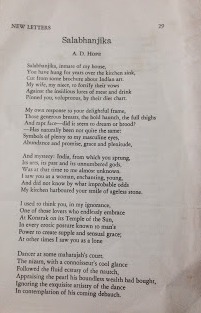
I will do my best to get this positioning of anecdotes in the right sequence. I chose them to illustrate The Power & Powerlessness Of The Exotic Status. If I were to express them as newspaper headlines, they would read: 'A.D. Hope Praises A Divine Image Which Appears In His Kitchen', 'Hercule Poirot Whole Heartedly Appreciates European Countesses'; 'Tess's Beauty Makes Her Stand Out From The Crowd'; and 'Chilean Ambassador Rapes The Woman Who Cleans His House'.

What do all these texts have in common? They are illustrations of how those who occupy the exotic status are singled out for public attention. That people who are called 'exotic' are often in fact categorised and diminished by apparent praise, and actually targeted by what seems to be admiration.  

The Eye Of The Beholder confers both Power and Powerlessness on the person designated as exotic. Noticeably, those described in these anecdotes are women, because the nature of womanhood seems to invite accusations of exoticism by men. Unwanted attention and the Uncreating gaze combine, in an act of interest and curiosity fused with desire and frustrated possessiveness. Men usually 'wrote' women, and constructed them as the unfamiliar to themselves. So - in a male-constructed world, a woman is the most exotic of creatures. 


This, to quote the generous-minded and traditionally-built Precious Ramotswe from the 'No. 1 Ladies Detective Agency' series, is well known! Less well known is that the famous Australian poet A.D. Hope wrote a poem which was a tribute to a voluptuous image of an Indian goddess which his wife and niece had affixed on the wall over the kitchen sink, as a role model for themselves in their quest to lose weight and 'get in shape'. Seeing her form and features every day inspired an endearing reverence in the poet. 


In Agatha Christie's Poirot novels, the Belgian background of her detective Hercule Poirot is central to her construction of him as a man profoundly different from the homogenic British, to whom he seems like a 'mountebank' and a 'jackanapes'. It is his brilliant brain, his generosity of vision, his tolerance, his empathy, his profound knowledge of human nature, which distinguish him. But it is his exotic, luxuriant moustaches which characterise him. So it was in character for Christie to describe HP as being attracted to exotic women: 
The young Hungarian Countess Helena Andrenyi in 'Murder On The Orient Express' is described as an exotic beauty: scarlet lips and dark eyes. She speaks English 'a leetle', and 'her accent is charming':
           "She lingered; her eyes watched him curiously. Lovely eyes they were, dark and almond shaped, with very long black lashes that swept the exquisite pallor of her cheeks. Her lips, very scarlet, in the foreign fashion, were parted just a little. She looked exotic, and beautiful."
          It later turns out that this gorgeous young lady is exaggerating her exotic appearance, to disguise her actual identity! But the point is made - exoticism and beauty are equated, in syntax as they are in life.
          Christie is aware that what is so visually appealing is easy to fabricate. In one of The Labours of Hercules, 'The Girdle of Hippolyta', a female member of a gang of art thieves does a quick change in the toilette of a train, going from looking like an awkward schoolgirl, unremarkable daughter of a Minister of the Church, to looking like 'a flashy piece of goods', appearing as the wife of a man whose passport includes a wife. What were her props? Lipstick, nylons, high heeled shoes, glorious little toque hat! What does her real face look like? 'Possibly only the good God knows!' exclaims Poirot. Here, exoticism because of the very familiarity of its brand and its constituent aspects and elements is again seen as a passport and a cover.
Exoticism comes naturally, however, to the Russian countess Vera Rossakoff, who appears unforgettably in Hercule Poirot's old age as a vision on the escalator in the London Underground. She is the definition of 'larger than life': a person of "full and flamboyant form; her luxuriant henna red hair crowned with a small plastron of straw to which was attached a positive platoon of brilliantly feathered little birds. Exotic furs dripped from her shoulders.'' She is fond of vibrant colours and layered textures, bedecked in jewels and draped in the spoils of war and the trappings of wealth. She is a compendium of desirable aspects: 'Chic. Sympathetic. Spirituelle... A femme du monde.' She also has a tremendously buoyant, vibrant, articulate personality, and 'good lungs': "To be content with what God gave you... That is arrogant!" she exclaims. She is 'a woman in a thousand, a million'. She offers fascinatingly detailed insight into what she does to keep up appearances. And 'she knew, none better, how to flatter a man':
          "Though it was something like twenty years since he had seen her last the magic still held. Granted that her make-up now resembled a scene-painter's sunset, with the woman under the makeup well hidden from sight, to HP she still represented the sumptuous and alluring... the flamboyant creature of his fantasy."
      Christie observes that 'It is the misfortune of small precise men to hanker after large and flamboyant women. Poirot had never been able to rid himself of the fatal fascination the Countess held for him."
          In her first appearance, she is described by Hastings as "a whirlwind in human form,... a somewhat disturbing personality... who invaded our privacy, bringing with her a swirl of sables .... and a hat rampant with slaughtered ospreys." Her energy is full of the life force we generally associate with men. It acts like a magnet on Poirot, who, full of himself, respects the strong personalities of others. She disturbs him, and he likes it. Note here that, in contrast to several other men in this survey, Poirot focuses on her lungs and not her breasts. :) :) :) :) :) 
So exoticism means only positive things to a broad-minded citizen of the world. And a man full of brains as well as ego not only likes a woman who pays attention to him, he enjoys hearing her speak. They are, despite their social class differences, allied in their status as foreigners, in London.
But away from the aristocracy of Central Europe, in the regional areas of England, to other kinds of people, this luxuriance operates as an invitation to become a predator. Particularly if the woman in question (unlike Poirot vis a via his Countesses) is of a lower social class than the man who appreciates her. We see this in Thomas Hardy's 'Tess Of The D'Urbervilles', from the description of Alec's first sight of Tess:
     "Tess had an attribute which amounted to a disadvantage just now; and it was this that caused Alec d'Urberville's eyes to rivet themselves upon her. It was a luxuriance of aspect, a fullness of growth, which made her appear more of a woman than she really was. She had inherited the feature from her mother without the quality it denoted. It had troubled her mind occasionally, till her companions had said that it was a fault which time would cure."
   The quality her exotic beauty denotes? Is clearly an indication of sexuality and sensuality, an invitation to the dance of life. And she has no shortage of potential partners. 
        Alec articulates his frustration, when it takes him some time to get her to respond to his meretricious advances: 'Good God!' he burst out, 'what am I, to be repulsed so by a mere chit like you? For near three mortal months have you trifled with my feelings, eluded me, and snubbed me, and I won't stand it!' He wants to give her 'the kiss of mastery'. She seems to be asking for it, doesn't she? Her luxuriance suggests so. 
      It is a familiar saying that Beauty is In The Eye of the Beholder. But it would be equally true to say that Beauty is described as being in the Face of the Beholder. And that the way the Beholder sees Beauty speaks volumes about the Beholder himself. Our attitude to the Exotic is an index of our biases as well as our preferences. 
     Take Tess for example. See how she appears, because of her exotic beauty, to a lot of men: to Angel Clare, to Alec D'Urberville, to the Captain of the Immortals, who 'sports' with her: as if she is unconsciously appealing to them.
Her luxuriance of aspect, her full figure, the red ribbon in her hair, her beautiful eyes, seem to invite their attention. But does that attention have to take the form of assault? She becomes a 'wounded name', a 'Maiden No More', who cannot escape the consequences of her exotic allure. She actually at one point in her struggles removes her eyebrows to stop people commenting on her beautiful face, feeling her beauty to be inviting unwanted and predatory attention.
         I began this paper by commenting on the dualism of perception which exoticism reveals in us. In this novel, the dualism is externalised through characterisation of Alec and Angel as binary opposites. Angel Clare, a better man than Alec, sees Tess from the start in a more emotional and spiritual way than Alec does. 
          " 'What a fresh and virginal daughter of Nature that milkmaid is!' he said to himself. And then he seemed to discern in her something that... carried him back into a joyous and unforeseeing past, before the necessity of taking thought had made the heavens grey."
          Unlike Alec, who sees her as a 'crumby girl', to Angel 'Tess...seemed to inhabit a dignified largeness both of disposition and physique, an almost regnant power, possibly because he knew that ... hardly any woman so well endowed in person as she was likely to be walking in the open air within the boundaries of his horizon; very few in all England. Fair women are usually asleep at midsummer dawns. She was close at hand, and the rest were nowhere."
             Here, as with A.D. Hope, we have a man who appreciates the divinity of women. Hardy is explicit about it: "She impressed him most deeply. She was no longer the milkmaid, but a visionary essence of woman - a whole sex condensed into one typical form. He called her Artemis, Demeter, and other fanciful names half teasingly, which she did not like because she did not understand them.
              'Call me Tess,' she would say askance, and he did."
     Here is a girl who can say 'No'. And a man who can accept it.
     Tess can say this because she is being approached by a man who is more evolved than most. He sees her sensitive feelings and her qualities of mind, as well as her beauty of body. He sees her as a whole person, and does not seek to separate her from her source, or reduce her. She can speak to him, in the imperative voice.
           In contrast, Pablo Neruda expresses his own conflictedness as a justification for targeting, an excuse for attacking, what he sees as other, several steps further in his Memoirs, when he describes the sexual assault he himself perpetrated on a Tamil maidservant while he was the Ambassador for Chile, in Sri Lanka in the late 1920s. It is a bizarre incident, for many reasons. I had been used to hearing of Neruda as a great love poet and a man who had great sympathy for the poor and oppressed. 
   What struck me from the first reading is the absolute brazenness of his hypocrisy. He praises her beauty, and likens her to a goddess, like the statues of goddesses in the temples of South India. But people worship goddesses, they do not rape them. It is other human beings they assault. Particularly those they consider vulnerable, in relation to them. This violent binary opposition in the way beautiful women are seen and treated has been brilliantly portrayed in the image we see here on the projector. Neruda's behaviour shows the transition between the two conflated approaches, and their violent outcome. 
He offers tributes, at first. He leaves gifts for her, knowing she is poor.  Colourful silk garments. But she ignores them. I get the impression that he was incensed because she ignored him. Returning to the Orient Express, it was Countess Andrenyi's alert and intelligent gaze that highlighted her beauty for Poirot. She was not only beheld, she was a beholder in return. She wanted to know what he thought, saying 'Why did you ask me that?' She connected with him.

In Neruda's case, in Wellawatte, he is made to feel invisible, and his advances are completely negated. One day, fuelled by both feelings of sexual desire and sociocultural and gendered entitlement, he decides to 'go for all'. He forces himself upon her. And he describes the act poetically:
        In 'I Confess That I Have Lived' (1974), he details the incident. Shall we read it, together?

Note that he describes her as a goddess 'made of stone', a 'statue'. She was silent throughout the encounter, and kept her eyes open. He states that 'that there was no language in which he could speak to her'. I wonder how SHE would have thought or spoken about the encounter. In HER memoirs. 
My point is that, by initially exoticising her, Neruda gives himself permission to do whatever he likes to her. She becomes an object, in his eyes. Even if his sexual imposition of his imagination, his desire, and his body on her was seen by him as an act of worship, it was not an invocation to a superior deity. It was, in contrast to the reverence expressed by A.D. Hope, an act of self-worship. A glorification of his own virility and forcefulness.
Her thoughts, her ideas, were not 'unknowable' to him. They were actually of no interest to him. His use of the passive voice is very indicative of this: 'The experience was not repeated', is the phrase with which he ends his description. A dismissal. Distance. Literally a throwaway line. He saw himself as a complex, living being, with a trajectory, a life. He saw her as an object, an incident, along the way. 
So, since this Nobel Prize-winning poet seems incapable of basic human empathy, I ask myself, 'How was the experience, for her'? (A question that Pablo Neruda did not ask himself, let alone the unknown woman.) The power differential between them is staggering: as a man of 25, as a Chilean Ambassador, as a man in the 1930s, Neruda had all the power, in this encounter. He was fully aware of her relative powerlessness in relation to him: as a woman, as a servant hired to clean his latrine, as a Tamil from the 'pariah' caste. Her powerlessness, refracted through the lens of exoticism, excited him. He was able to blame her beauty for exciting his desire, and also use her socio-economic status as a justification for his treatment of her. In a real sense, her exotic beauty is used to excuse his response to it. 
     So as the honey-coloured deities we are, we people of colour, we unusual, different, colourful people, should be careful when people pay us compliments on our alluring beauty. It is a short step, easily taken, from being admired - or worshipped - to being mistaken for a piece of exotica. 
     In a more generous era, inhabiting the exotic status meant being admired. Today, in a world where everyone is under stress, being seen as different or other can get an exotic person attacked, accused, deported and killed. It is a dangerous position to be in. And it is not a passive position.
       People, in the end, return home from even the most exotic holiday, back to a less unsettling, exciting and dangerous setting - which they usually prefer.  And what was initially seen by them as alluring and exotic becomes an experience they once had, and eventually an image on a fridge, and something to be boasted of, in a self-glorifying memoir. Human beings are like that. We reach out for what we see as beautiful because sometimes we feel empty inside, and our disrespectful touch depletes it, and makes it wither on the vine. From The Wide Sargasso Sea, under a Bitter Moon, we must be careful about how we are seen, and how our identities are constructed, and by whom. And we must be thoughtful about what, and how, we also in our turn allow ourselves to see.

Thus Spoke Theena: A Review of First Utterance.

Published in Ceylon Today

First Utterance, a self-published book by Theena Kumaragurunathan, has just been given the first prize in the second Fairway Literary Award, in the English category. It is a breakthrough book, in several aspects: it is short, it is extremely affordable at Rs.150, it is a work of mythic fantasy fiction, it successfully incorporates elements of poetry, drama, satire and magical realism, and it is the first volume in a story cycle. Above all, it is a self-published work, and this augurs well for future writers in Sri Lanka.

I suggest that the judges of the 2016 Fairway Award should be awarded a Commendation Prize for thinking outside what have come to be seen over the past few years as the usual parameters of Sri Lankan literary culture to value a work of mythic fantasy. This award is literally a ground-breaking event. 

The subject matter is epic. The back cover introduces us to 'The story of three men, deemed mad in a dystopian world, who shirk reality for dreams, music for silence and sanity for peace,' and urges us to 'Plunge into Mirage as their collective fate brings a world to its knees and heralds the end of time itself'. 

Most works of fiction created in Sri Lanka have been set in a world which is recogniseable to us: contemporary reality, rural or urban social realism. This story immerses us, as the energetic exhortation 'Plunge' indicates, in a wholly otherworldly hyper-reality which is recogniseable and accessible to us in an imaginative, allegorical and metaphorical way.

The other world created in this story is called 'Mirage' and its name evokes not only an oasis in a desert, a respite in a Wasteland, but Maya, Samsara, the illusions of this material world, from the Indian legends, which positions the realities experienced by human beings as occurring in a realm which is a testing ground for the soul. The characters, linked by their conditions of mental instability and problematic relation to the 'real' world, are on quest. The outcomes of their quests are not predictable. 

As I read, I sensed modernist and archetypal as well as apocalyptic aspects whirring simultaneously in the text. Huxley's 'Brave New World' is invoked, and T.S. Eliot's apt comment on the twentieth century as being 'a vast panorama of chaos and anarchy' is evocatively present, and there are distinct elements of prophecy resonant of Yeats' Byzantium poetry  - the unmistakeable breakdown of one form of reality and the emergence of a new form - the need to create a new language to express a new condition of the heart and mind and spirit - to which the story provides access, and for which it creates a resonant vehicle. 

This is the most transitional of times, in which we live: all the structures which formed and informed our lives and created continuity are being taken down and shaken off. The radical indeterminacy, the constant reactiveness into which we are compelled by rapidly changing external circumstances, the continuously interrogative nature of our response, is a highly stressful and volatile way to exist. 

The inherent stress and distress of our human condition is perfectly expressed in Kumaraganathan's fusion of elements, and the dystopic society he delineates is permeated with the dissonance and discord which characterises our own world. Warring elements never really resolve into harmony. Tense exertion holds dualities in place, but we sense this will devolve into another form in the next phase. This friction and disquiet is reflected in the integrating vision which connects the structure, the imagery and the syntactical rhythm of the book.

The book is a medley of utterances, and the first is female: Mirage herself speaks, in the form of a Mother, a Cosmic Mistress, counterpointing the book of Genesis and the imposition of order on primordial chaos. She, with her female energy, pre-empts and pre-dates patriarchy. 

The female human figures in the rest of this story cycle will I hope take their cue from this multi-dimensional inception: most women in contemporary fiction are presented almost exclusively as vessels and objects of sexual release for the men. In an alternate universe, a more evolved state of relating would surely be imaginable between the sexes. The creating vision in Part V is a blend of strength and gentleness, an antidote to testosterone-fuelled Shock and Awe:

'We heard a voice from atop Peak, the voice of a woman - so powerful that all of Mirage could hear her but so gentle that it blew out the flame of fear in all of us.' 

The three tribes evoked in the story, each with their patrilineal lineages and books of scriptures, allegorically envision the political struggles of people from different faiths and belief systems to co-exist in one land. 

The big picture offered to us of struggling human beings, with its potential for chaotic veering and derailment, is grounded by the stories of variations on the nuclear family: a father, his wife, his daughter, Adi. His detailed concerns about how he can protect and sustain them. 

In the section 'Naming The Nameless', we meet Anne, whose husband, 'one of the outspoken  critics of President Mahasen's administration, particularly the little-debated but speedily-enacted Psychological Cleansing Act 2190 that targeted the mentally frail', had been made to 'disappear'.
On February 2nd, 2222 President Mahasen VIII apologises for acts of violence committed against citizens by his father, the previous President. This section of the story is so poetic that it conflates myth and reality into wholly specific and original political satire. 

The divergent elements and rapid scene shifts move us into close-up and then back up again to panorama, and the author's narrative control is powerful, because it is inter-aligned, segmented, and flexible. The tone is temperate and detached. Nothing tips into chaos. 

Imagistic elements such as The Peak of Butterflies and the empty Emergency Room rest interred in our minds, as we read, in the cubic centimetres of space that remain our only possession, in Orwellian-speak, and which are under threat in an era in which not only people's ethnicity or religion are targeted by those in authority, but their personal mental and emotional states. 

The cast of characters includes a President (Mahasen VIII), a mass of journalists and editors, and administrators, doctors and staff of asylums and hospitals for the mentally aberrant. Could there be more appropriate people presiding over the ending and beginning of worlds? There is also a Chorus, mediating between the action and the spectators, and entertainingly operating as a nervous MC, so frequently interrupted he finds it difficult to do his job. 

In the last sequence of this story, the President throws his broken wristwatch into the bonfire in which the Book of Mirage is burning. With, as is the manner of Presidents, a few, well-chosen words: 

'And when it ends, those of us who have the task of sitting idly by have already made our choice because we know things end. Everything ends, doesn't it? Things just stop working for no rational reason. This hasn't worked in the 19 years, 43 days and 18 hours since you died. It is the way of the world. Everything ends. And yet, I didn't stand idly by. I stood up and fought against forces you couldn't imagine, old man. I tried. And I failed.' He looks up and sees all eyes upon him.

It is refreshing to hear the words of this mythic President deal not with war or economics but existential philosophy! 

The Miragian Cycle has started to spin. A testing ground in which we see the universe we used to think we knew become a multiverse in which we see ourselves reflected more fully. 


Wednesday, June 7, 2017

Barriers, Bridges & Bright Young People

Review of the 'Work In Sri Lanka' Conference at The Kingsbury Hotel, December 22nd, 2015.
Published in Ceylon Today


This is the third year that the 'Work In Sri Lanka' organisation has convened a conference to encourage expatriate Sri Lankans to 'come home'. A whole day of presentations by speakers was intelligently interspersed with interactive panel discussions and participatory group brainstorming sessions, and it was a successful and encouraging event. The theme of the conference was 'Breaking Barriers, Building Bridges'.

  The speakers were direct and honest, and ready to share their challenging experiences and frustrations as well as their accolade-embossed resumes. There was - to the audience's great relief - no grandstanding or self-indulgent, hubristic posturing of the 'much fanfare no substantial outcome' school of public event organisation. The speakers on this occasion each had their personal egos under good management, and were focused on the big picture.

      What I found of particular interest was that the 'Barriers' and 'Bridges' encountered in this reverse migration process were seen not only as external facts and figures, demographics and statistics, as detailed by the Deputy Minister for Public Enterprise Development in his opening address, but also discussed on a more subtle and personal level, in terms of actual lived experiences and pressures operating on individuals in their lives.

   The golden island icon at the centre of the visual backdrop for the platform subtly pulsated with lights and electrical currents throughout the proceedings. The subliminal message of this was strong, and supported by every presentation in an integrated way: that the time has come for the far-flung, much-travelled daughters and sons of Sri Lanka to return home. The reverse migration has recently begun: Lankan children and grandchildren have started to revert, to return to source, to re-settle in the country, to delight the eyes of their parents - and to invest themselves, their skills, their hopes, and their progeny and resources, in the land of their ethnic and cultural provenance.


   The 'brain drain' of the past is being transformed into a present-day 'brain gain'. This terminology is of course not exactly a compliment to the owners of the brains who have been here all along.


The people who spoke in the panel discussions had all been able to gain access to education abroad: in Britain, in Australia, in Europe, and the United States and Canada, usually through an International School examination sitting, and subsequent undergraduate or postgraduate training and professional experience in a 'developed' country.

Their reasons for coming back were individual and diverse, but usually centred on family ties, in some cases family business and property, and filial consideration for the older generation of parents and grandparents who would otherwise be cut off from knowing their Westernised grandchildren in any meaningful way.

      Is 'home' where the 'heart' really is? For expatriates, and particularly returning ones, 'home' is often not a clearly demarcated location. And the 'heart' is neither easily accessed nor understood.

Several people noted the ways in which  'traditional' aspects of Sri Lankan society, and its 19th century hierarchies and rigid social structures, operated as barriers to their sense of freedom and fulfilment, and how liberating it had been to experience life in societies which were more progressive and self-questioning, more set up for business and organised and transparent and accountable, where 'business as usual' was a norm, a guarantee, and not a bonus.

The contrast between expectations and reality is sharp and significant, and these discrepancies may at times lead us to form perceptions which may not be accurate. One of my friend's family memories is that, when a relative of his was very young, he had told his cousins with great authority that Bombay (as it was then) was an 'underwater' city, simply because the plane had stopped there briefly during the monsoon.

That is a child's eye view, but it sometimes feels like that. It is profoundly disorienting, as though you are moving through a different and intrinsically unfamiliar medium, where it is difficult to operate with skill or grace, because it is water, not air, that you are traversing; curves and implications and ambiguous fluidity you are interpreting, rather than clearcut angles and facts and specifics; and translucent layers of resonant history, not the realm of the clear and present day, which you are seeking to navigate.

  An expatriate returnee often faces scorn, resentment, misplaced envy and derision. They seem to be professionally courted and openly valued by local employers over their locally-educated counterparts, and are consequently hated by their co-workers for their foreign credentials. They are often seen as arrogant, entitled and condescending, because they speak in British or American accents which they do not attempt to modify with Sri Lankan idiomatic phrases or culturally inclusive mannerisms and gestures.


     Returnees are often frustrated by the apparent evasiveness and indirectness prevalent here, which seems like hypocrisy to someone brought up to speak and be spoken to in a more straightforward way. They are frequently startled by the levels of unchallenged ethnic and gender-based chauvinism which they encounter in every echelon of this society. Their frustration and disillusionment is interpreted as an indication that they are 'spoiled' and 'ungrateful'. Elitist brats!

The common denominator is surely this, and it is an uncomfortable truth to admit: every returnee faces the often unspoken but powerfully insulting perception/accusation that their perceived privilege was not earned by their own effort or their individual talent. Instead, they are now seen as being 'where' they are, with more opportunities and qualifications in a competitive marketplace, only because their parents were financially able to leave, while those who stayed could not: to seek opportunities for self-advancement in other, less troubled and dysfunctional countries. Misunderstandings and offensive comparisons abound in relation to this stereotype, and its implications.

I was recently told that many of those who left Sri Lanka in the 90s in fact educated their children in relatively 'dubious' universities abroad, but that the children who were these 'gold-plated' products of overseas training were still seen as 'superior' to more talented local students and professionals - whose 'Lankanness' brands them as 'second' or 'third-rate' in comparison. This is colonial cringe operating in national disservice.

My own observation is that Sri Lankans abroad are very competitive, and keen to acquire the best of what is available in the world: they have competed well internationally, and been very successful. Many of the best, most qualified, and most highly respected professionals in the world are - disproportionally - Sri Lankan. The generation which was educated in the 1940s and 1950s went forth and explored the world in a way which produced an open minded global access that subsequent generations were denied. Now the economy is growing at an impressive rate, and national expectations and aspirations are in lockstep with it. The 'traditional' society is changing forever, around us, and our beliefs are altering within us. And we are creating and participating in that change.

The socio-cultural challenge the country faces now is: in what ways can the country of origin make it worthwhile for its expatriate children to return? Instinctive, unquestioning love for their Motherland is not ingrained in them. They have not sacrificed anything for the country of their ancestors. They are largely removed from its rituals. They have been brought up in a materialistic global culture where (to paraphrase John Pilger in his brilliant documentary on globalisation, 'The New Rulers Of The World'), every human value is affixed to a dollar sign, and assumed patriotism is no exception to this reality.

The question they ask themselves when they do return is: can the pluses of the re-orientation process incrementally outweigh the disadvantages? Can contemporary Sri Lanka find and develop a middle way between welcoming them with open arms as investors and skillset providers, and yet simultaneously in practice deriding and 'white-anting' them for their perceived entitlements and their educational and professional privilege?


We were told at the commencement of the conference that we needed to re-imagine and re-visualise our current reality. That 'the past is the result of the present'. The past was a quasi-feudal society; the present is a much more fluid one, trying on many versions of itself to see if they fit, positioning itself with pride and acquisitiveness, aspirational anxiety, and a certain amount of preening, in a rampantly global world.

        To really facilitate the choices of returnees, the differences & the reasons for these differences between local and international experiences and realities need to be faced: differences in actual quality and effectiveness of education, in standards of professionalism, in direct access to beneficial aspects of global culture, in moral awareness, in generational gaps and disconnects, in attitudes to ethics and codes of conduct, in working knowledge of human rights, and socially progressive challenges to damaging forms of cultural privilege.

     The most obvious and understandable barriers returnees face, as they are ushered in to the new Sri Lanka, lauded as young internationally educated professionals, returning to make their mark and steer the country into renewed prosperity, are professional jealousy, and petty-mindedness. People who did not 'make it into the ark' were deluged by diverse disasters, and these tragedies have certainly left their mark on the old folks at home.  Returnees reconnecting with their old schoolmates may find that under the fraternity and sorority there are unconscious and understandable hostilities also. With no recourse but to work in relative isolation, restricted, underpaid, subject to social limitations and operating in combative mode due to thirty years of cultural chaos and social dysfunction, professional people here can often seem bitter and disappointed, ground down and weary, to someone coming in to the culture.

     It is clearly difficult for human beings on both sides of barriers and bridges to offer each other benefit of the doubt, when they themselves feel disadvantaged, or to collaborate and find common ground without compulsively competing and taking offence at differences that are pretty clearly pre-determined, by different upbringing, contexts and experiences.

      Barriers and bridges are often made from the same materials. Breaking and building are two sides of the same coin, and can be seen as opposite but connected forms of value.

     Several participants in the conference panel discussions noted that the more obvious shortfalls and deficits in this country provide a vibrant opportunity for entrepreneurs, and people who wish to contribute socially in the long term to make a visible and direct difference to the society. Certainly, if the defeatist mindset and iterated cant of 'this is the way it has always been' can change, even profound stagnation can be reversed, and innovation and openness of ideas and commitment to greater effectiveness would transform the reality of living here, and not only for a few. The country would surely then not be called 'our Blessed isle' with irony, by its inhabitants.

Review of 'Phoenix', a collection of poems by Anupama Godakanda

Published in Ceylon Today
RE-CALIBRATIONS OF THE SELF

'If I had a black box instead of a heart
Where the heart should be, 
wherever it is, /
That faithfully recorded my life,
That, I believe, would take the joy,
The sheer wicked thrill, 
Out of the telling of all those tall tales I tell'...
('The Black Box') 

This collection of poetry, published earlier this year, has a clear and persistent discernible pulse. As the title implies, there is a portrayal of struggle, episodic and cyclic flights from frustration, a dialogue or altercation between binary oppositions and dualities, and eventual emergence, stark or muted, in every poem.

The poet herself identifies her recurrent theme in her Preface:

Her focus is on 'serendipitous moments of honesty' which cause her to 'meet [her]self face to face naked of all subterfuge'. This brings into focus the idea of a dulled and mundane, at times chaotic, reality, interspersed and riven with aspirations and fierce strivings. The struggles are internal: longings for access to an alternate, exalted sphere, triggered by external events. The reader sees, across the range of poems, that the longed for portal opens for the poet only in intermittent moments of awareness and clarity.

Godakanda says of herself that in those moments 'something in me dies and in its place something finer, I would like to think, emerges from the ashes of the perverted thing that has died. In between these unceasing moments of life and death my time is mostly spent on waging a constant battle against those forces within me - which are not really of me, but smuggled in by those forces from without and grafted against my wishes to my very being - that try to keep me from that enriching cycle of death and rebirth'.

 Here the poet introduces her persona as a combatant, experiencing her psychological and socio-emotional life as a form of constant warfare, with her essential self drawn into unremitting skirmishes, but yearning for unencumberment, full personal  franchisement, and peace.

Many of these skirmishes are dialogues (or partial dialogues) with lovers, and deal with the failure of physical love, with its often egotistical misapprehensions and
limitations, and inevitable and messy sharing of the partially discovered self, and its continual failure to provide the access to
the personal peace that the persona longs for. Some are evocations of friendships which have become unsustainable, with life's remorseless individuation process drummed into their unravelling, in cycles that seem inevitable.

 These personal conflicts take place in a wider and more fractured and destabilised societal sphere, in which injustice, condemnation, shallow judgment, misapprehension and cruelty distort the communication that could provide release and solace for people. The strength of these poems is that, although they are often clearly responses to personal experiences, they are not all merely personal accounts, but are of interest and relevance to the reader.

     Central to their effectiveness is the poet's own frank admission of her impatience with the falseness of the norms and expectations levied on us. She invokes the social forces she is often warring with in prose in her Preface, in the form of the third person reported strictures of those who seek to scold her into conformity with acceptable contemporary models of conservative female behaviour:


'It is better to go on as it is, they say. Toe the line, less trouble, they say. But I choose not to. A declaration of war... And rarely does myself emerge victorious from these many skirmishes. However, these defeats, instead of crushing myself down, are often the very stuff that set me on fire so that I could turn to ashes once again and emerge from my pyre a little closer to myself'.

 I find this powerful claiming of this 'pyre', as a form of wholly personal redemption and renewal, liberating. In my mind's eye, in response to these words, and as I read the poems, I think of the fire of purification, of Rama and Sita, circling the sacred flame, the ordeals of social sanctification endured by women, and the fire of suttee in which faithful wives were expected to immolate themselves for their husbands' greater spiritual ascension. The woman's identity often seemed subsumed in the relationships women had with men.

So this poet's embracing of a life created by internal self-immolations is subversive. Even in its often perceived overall or individual 'failure', tracked in each poem, I find the tracing of the poet's challenges to the dominant paradigm of female compliance very effective as a portrayal of an alternative to mainstream behavioural conformity.

    Images of fire, of comets, and transcendence, operate to integrate the poems thematically across their diverse forms. Martial imagery and astronomical references are invoked, appropriate for a celestial appreciation of life's required combats.

   It is evident that these personal wars and battles are clearly more important to the poet than the political struggles of the country around her. These are invoked but she does not allow them to extinguish the flames of her personal anguish, or douse her personal rebellions and uprisings with a collective mass of depersonalised sorrow. There is a capacity for objectivity, detachment and broad perspective manifest in her work, which makes her direct treatment of everyday and personal disappointments very interesting.

   Godakanda uses references to Classical mythology and archetypes to expansively broaden the framework of several of the interchanges showcased in her poetry: and allusions to Indian as well as Greek and Roman mythology, and Christian doctrine.

   'Narcissus! Narcissus!', addressed to a younger lover, shows the persona strongly inhabiting an imaginative space of cultural strength not usually accorded to women who cross age lines in their romantic relations with men in traditional societies, and using classical archetypes for her personal self-empowerment:

'You beautiful boy-man
Looks fade and you grow old, sweet boy-man/
I, Echo, have seen so many like you
Preening and posing
On the surface of my lake...

Men come, sweet Narcissus,
To my life-giving pool,
And then they go,
When it is time to go -
But I, Echo, the keeper of life
Stay.'

  The self-esteem and self-respect in the poet's tone here are further explored in 'Lucifer, I See You In Me', where the persona's identification as a woman with the socially condemned pride of Lucifer is portrayed as a necessary strength, in a world where she is often called into action, to affirm as well as defend herself:

 'Pride goes before a fall
  I have heard many mutter
  As they pick themselves up
  Dust and put the pieces of their broken lives
  Back together -
  Little pieces missing
  Lines not exactly meeting
  Humbled beyond words
  Looking for meaning
  In dusty volumes
  Until the next fall.

  I march towards my end,
  No heaven or hell,
  Until I too fall down -
  Yet, no Book would I turn to
  In despair for hope.
  Instead, reach deep within my being
  And gather

  That slow-burning Promethean Gift
  Between my sheltering palms.
  With that to guide and light the way,
  Once again
  I walk head high,
  Battered and bruised,
  But not broken.
  Lucifer, I see you in me.'

  The relatively cliched final phrases 'battered...bruised/But not broken' are not threadbare but original in their placement in this cumulative sequence, as the evocation of the image of the 'slow-burning Promethean Gift' of fire held by the persona in her 'sheltering palms' suggests an invocation of the sacred which enables her to transcend the struggles and frequent indignities she encounters in the path of her life. Images of the vulnerability and fragmentation of the self cited during the passage of the poem are thus denied by the alliterated end focused phrase 'But not broken'.

  Godakanda in her most effective work does not clutter or freight her poetic syntax with overwrought description, and her images are free of self-referential and self-conscious posturing. In 'A Closer Fit', she directly addresses us, the reader, with an abruptness that is endearing, and revelatory in its indication of her awareness of our shared human condition:

 'My skin does not fit right;
  An imposter in clothes
  Borrowed, begged, or stolen,
  That is how I feel, day in and day out;
   In places it pinches sorely,
   Too young to be me;
   In others, hangs loose
   In wrinkled, flabby folds
   That looked not even remotely like me,
   From afar, at least.
   Slink I into shadows cracks and nooks,
   In shame when among those
   With tailor-made skins, just right,
   The way they hang, chameleon-like,
   In vain, I know, do I stretch and shrink,
   A caterpillar gone mad in its chrysalis,
   Nip, tuck, and suck, endlessly,
   Looking for a closer fit.'

   The frustration of the process of emergence from felt constraint is powerfully expressed in the climactic metaphor 'A caterpillar gone mad in its chrysalis', and the diction derived from dressmaking is particularly appropriate as a description of a woman rejecting the ill-fitting and unsuitable measurements made of her by her society. Here in Sri Lanka we are particularly aware of the many 'fittings' required for the dresses and garments that are tailored for us, and the various efforts required for us to feel as if we are physically appealing, and approved of. Even the most liberated of us wonder at times if we fit, or fail to fit, the models held up to us of female beauty and desirability.

   The poet's evocation of youth and age here, as equally uncomfortable extremes, shows her prevalent desire to find the unique 'fit' that expresses her sense of her true self, rather than the 'imposter' that she rejects, who is constructed often inadvertently in response to the dictates of society.

  In 'The Cup Of Life', she describes herself as 'waiting for my cup to fill,
   With memories bittersweet,
   Dissolved in sweat and tears.
   One final drop,
   And then I will drink it
   And fade in a euphoric mist
   Into an eternity beyond everything.'

   In this first stanza, the phrases 'bittersweet' and 'sweat and tears' seem slightly tired, but the syntax and enjambement ensures overall clarity of meaning. The flow of the second half of this poem, however, is disrupted by unrendered words, which cluster claustrophically and do not allow Godakanda's own voice to free itself from the trappings and implications of well-known phrases:

 'Yet, I have lost count
  Of those drops,
  Seeping through the very cracks of life,
  Trapped in a hazy, labyrinthine mist
  Of life-choking mind-numbing memories
  And am still awaiting
  Breathlessly, hesitantly,
  For that final drop,
  That magical catalyst,
  To fall.'

The blurred abstractness of this idea, its unconnectedness to any specific image, obscures its meaning. Godakanda expresses a similar idea more effectively in a more physically concrete form in 'To Be Joyful Of Little Things':

 'A drop of nothingness
  Hanging pendulously,
  Swinging, quivering
  In the morning chill
  On a blade of the sidewalk's crushed grass;
   A little no-name plant
   Pushing itself staunchly
   Through a crack
   On the pavement,
   Despite being smashed,
   To pulp, day after day,
   By the pounding feet
   Hurrying along to nowhere;
   The one true note
   In the repertoire of screeches
   Of the fake-blind man
   With the cracked violin
   At the corner by the lights;
   One perfect ray
   That cuts across the choking smog
    And falls at my feet
    And follows me, and then guides me
    On my way
    To yet another yesterday, today, and tomorrow;
     Little things, they surely are,
     And they are all I have,
     Yet to find joy in them, I have learnt, finally.'

  The inverted syntax used here in the end focus of the last line very effectively positions the persona's unexpected realisation of joy inherent in the diurnal progress in which we pursue our various sacred grails.

  The most powerful overtly political  statement in the collection is the long poem 'Let Me Cast The Last Stone', a portrayal of the state-sanctioned ritual murders of women which take place in countries adopting punitive and manifestly unequal measures to publicly condemn adultery and sexual 'impropriety'.

 'Let me cast the last stone
  At that Brown-bodied Woman
  Buried waist-high
  Runnels of sweat and blood
  Streaming down...
  Straining, as she braced herself
  For me to let go of that sharp-edged flint
  Whizzing through the air
  And hit her bloodied, ravaged body
  Once more.'

The poem, with its topical subject matter, runs the risk of being usurped by the 'incident reportage' style in which real events are responded to with emotiveness and often gratuitously violent faux profundity, and simulated outrage. Godakanda prevents this by her positioning of the textures and physical details, and judicious use of sequential plosive and sibilance to portray the perpetrators in relation to the victim of the unfolding events.

  The woman being stoned here fragments from within. Initially, she is:


 'Confident, still...
     That those sons and daughters
     Of her ancient line
     Would shield her from more stones,
      Chase the infidels out
      And let her breathe once more
      A lungful of liberty.'

    The scene of her dissolution is simultaneously shown in 'real time' and placed in a historical contextual framework, in which the first stone is 'Cast by the White Sahib', and the last metaphorically by the persona herself. The persecutors are disturbing versions of the victim's own 'darling child,/ Savouring the often regurgitated cud
Of post-imperial anti-capitalist cant'.

The sado-masochistic and self-justified cruelty of the perpetrators of the killing is as accurate as a televised replay in its close-up poetic, measured detail, evoking and summoning the covert voyeur in the reader:

'Picking up a jagged piece
Running a testing finger
Over the sharp edge, sensuously
Weighing the thing
Turning it this way and that
To get a better grip
Before letting it fly
Whizzing through the hot noon air.'

The persona expresses the wish to cast the last stone to 'free her/ So we could bury her
Under the cloak of the approaching night'. But this action is not merely motivated by mercy, or compassion. It is an incitement to finish it off, to get it over with:

'So we could get on with our lives
Wading our way through
A quagmire of the post colonial slush
Sucking it up to the White Sahib
In absentia.'

The deliberate use of the inclusive plural pronoun 'we' in this implicates us all in the event, and indicates the eroded problematic situation of anyone in a moral void, where indeterminacy prevails, and post colonial issues create a 'quagmire of...slush', trying in vain to locate ground on which to stand. Any certainty here dangerously devolves into judgment or condemnation of an 'Other'.

Human connection eroded, other people's suffering is seen as a vacuous spectacle, an enactment in which the figures' claim to life, through relationship, constitutes the reason for their death, and their existence, judged, and castigated, is mindlessly and heartlessly absorbed by the machinery of the state.

'Phoenix' is a guided tour through the thoughts and impressions of a person of interest to us. The sentimental caterwauling we are, regrettably, as readers subjected to, in various forms, by writers of contemporary poetry, is refreshingly absent here, where the 'black box'  of the awareness which has been substituted for the 'heart', often clearly registers the re-calibrations which generate and renew the poet's equanimity.


Eyes On The Prize

Published in Ceylon Today

Many people will recall the old nursery rhyme of 'Little Jack Horner, who sat in a corner eating a Christmas Pie'. I am not sure what other ingredients are contained in this pie, but clearly the most delicious and most desired by Little Jack himself is the 'plum' which he pulls out of it. Many people in the modern world still use the term 'plum' to describe a much-desired accolade, opportunity or position, and 'the plum' is a phrase often used to describe literary awards.

     I am writing this article in the immediate aftermath of this year's Galle Literary Festival, at which I attended a very interesting Panel Discussion where 4 judges of literary awards and a Moderator addressed some of the central concerns that had arisen for them during their experiences of selecting and awarding the novels, poems and other texts which have won selection in the Long and Short Lists of awards and prizes in literary contests over the past 10-15 years.

One of the panellist speakers commented that the obsessive focus on prizes and awards for 'the best' work of fiction in any particular year was misplaced. It put everyone's attention on the monetary value of the prize, emblematic of its cultural value, and on the wave of publicity and intense attention that accompanies the photo shoots and gala receptions and spate of media write-ups that bubble up like fine champagne in the wake of the grand announcements.

     Literary awards are truly examples of social Darwinism in action, and we can all relate to this observable phenomenon. All human beings like to be appreciated, and wish their aspirations to be fulfilled. An award, particularly a lucrative or 'well-endowed' one, (a phrase which brings to my mind voluptuous people, whose generosity of spirit is reflected in their generous physical beings and bodies), lifts the awardee above the crowd of their assembled peers.

      This new, elevated spatial position of an awarded writer and the cultural visibility that it generates arouses much petty envy in the hearts of their compatriots and fellow-contenders, as well as the sincere acclaim and praise of those who love to read, and like their work for its merits.The celebrity status of all kinds of professional people are now part of our socio-cultural landscape. They are quoted on all manner of subjects, and their opinions are cited by their fans as inspiring slogans and mottos, and disseminated on Facebook and Instagram like sparks of creativity and wisdom to ignite the world.

     And since the 'plums' are on offer, and there for the taking, those who hold their hands up and out and 'stick in their thumbs' do so for different reasons. Winning Rs.1000,000 or 500,000 is a big win for anyone who pays bills, rates and taxes. Winning a 'plum' award for creative expression signifies success of another, more subtle, less evident kind.

  The panellists commented that it was clear to them, as they read through and across up to 80 texts presented for their judgment and critical assessment, that in many cases the contestants were 'writing to win', with a formulaic approach and a manifest check-list of thematic content and stylistic features which they believed would yield their submissions the acknowledgment they craved.

      The judges expressed the view that some writers perceived that there was a system in operation, with rules both overt and unacknowledged, and that, if they could just work out what these codes were, they could play the system like a pinball machine and win through eventually to the Mount Olympus where the deities of literature reside. So, for example, those who set up the awards could specify that the entries must accurately reflect the culture and socio-political realities of a particular region, or nation and be a recognisably valid expression of that culture. They could do this with a wish to promote the literature of a particular region, to enrich the spectrum of literature.

       How could this constrict and constrain writers who wish to write in the genres of fantasy or magical realism? If narrowly interpreted, such requirements could exclude some of the best imaginative writing a culture could produce.

       Past awards and literary prizes have attracted considerable criticism, from commentators who have questioned the prizes themselves, their selection processes, and the qualifications of the judges who have agreed to perform the assessments. Several past winners of many of the national literary awards in this country have been criticised on personal grounds as well as for the quality of their work, which was in some cases derided and decried as unworthy of being read by a serious reader, let alone awarded a prize.

      At this panel discussion on Literary Juries, this paradoxical situation was addressed, and to some extent illuminated. One of the judges stated his frustration that he and the other judges had been expected to award a prize each year, even if there were no works of good quality presented. This was because the sponsors of the prizes and awards were 'adamant' that it would be discouraging for the prize not to be awarded in any given year.

As a result of this preference, the judges found themselves having to sift through works which they did not consider to be of good quality, to find the best or 'least worst' piece of writing: to which they then proceeded to award the prize. This comment led to a suggestion in the Q & A session that prizes could be awarded for 'worst' rather than 'best' works, as a possible deterrent to the production and awarding of bad literature.

      However, even if this comment was not taken seriously, the point was raised publicly that such a position taken, to award works of literature comparatively, rather than by objective standards, could result in 'bad' and 'good' literature being virtually indistinguishable, in terms of their being awarded prizes and the recognition that goes with them.

     The openness of this discussion also gave us insight into what many have observed as the disrespectful and 'attacking' nature of much of the reviewing culture in Sri Lanka, in the field of English literature since the 1990s. One reviewer has even described his subjects and targets, the writers submitting their work for these awards, whether with humility or with an air of magnificent carelessness, as 'attack worthy'.

     In fact, if you read a great deal of these reviews and comments, both printed in the national newspapers, and published in online blogposts and via social media, it is noticeable that some of the so-called critical reviewing being performed over the past 15 years was being written by people who at times actually undermined their own authority by commenting not on the texts they were supposedly discussing but on the author's political position, on their socio-economic status, on their physical appearance, their sexual preferences and gender identity, etc. In fact, as raised in a discussion at the EWC Seminar in August last year, these reviews read more like items in a society gossip column than serious comments about literature. They gave more insight into the viewpoints, ideologies and compulsions of the 'critics' than they did into the work of the authors. As one senior academic has noted, they 'were rich in detail about everything - except the text itself'.

      Some of the most vociferous commentators were seen by many senior academics and writers to be 'noise-making' in an effort to make themselves known. Several were not above rising to acclaim on the 'dead bodies' not of their own former selves, but of those they had critically eviscerated, whose works they had summarily dismissed, along with the 'right' to write them! When they themselves were eventually awarded the glittering prizes which they had been loudly decrying when they were won by people other than themselves, such 'plums' proved so delicious that these cultural warriors became markedly sweetened in their subsequent discourse!

      Note that, in the poem about Little Jack, our hero starts from a position of marginalisation, 'in a corner'. When he pulls out the plum, he is able to feel himself worthy of his own admiration as well as the respect and praise of others: 'What a good boy am I!' he endearingly exclaims. And certainly, the experience of winning a major award generates a powerful feeling of self worth and carries with it a 'feel good' factor. One is temporarily exalted: liberated from one's labours, and all the cumulative frustrations and difficulties of everyday life which writers must contend with, in order to produce a work of serious effort. You are front and foregrounded, no longer in the corner, or shut out from the epic epicentre of everything, which looks like the ultimate elitist gated community, from the outside, looking in.

      If the awarding of prizes creates a gated community, then those who create, set up and administer the awards are seen as gate-keepers. Certainly, given the small number of people writing in English in this country, in relation to the whole population, it is obvious that there have been until now only a few contenders for the awards and prizes of the past, both as entrants and as judges. It certainly seems as though the same names have come up year after year. This could be seen as a remarkable sign of consistency - or as a 'rounding up of the usual suspects': a sign of not much progress or diversification.

       The panellists all agreed that it was not the prizes or awards that were important, but the actual process of writing which results in the creation of a literary work, and so the focus needs to shift towards appreciation of the pathway to the production of good work, rather than being fixated on a glittering prize and an award ceremony which leads to a gold sticker being affixed onto a book at point of sale.

      Ignorance of the actual creative process of writers is possibly the cause of the manifest lack of pathways to publication thus far, and the lack of support & encouragement in the form of sponsored Workshops, Mentoring, Internships, Symposia, Forums and Professional Organisations in existence up until now.

     The CEO of Fairway Holdings, which has undertaken to sponsor the Galle Literary Festival for 5 years, made it clear in his speech at the inaugural Fairway Award last week that the company sees that the support and encouragement of good writing between award ceremonies is what will lead to the flourishing of a vibrant literary culture in Sri Lanka.

     This announcement, more than any other aspect of the Festival, signalled to me that today a change in mindset is at last occurring: a move which will encourage all participants to shift from a concept of competitive and ego-driven striving to a more generous, inclusive and giving imperative.

       The perceived and actual rarity of rewards, and the cultural void and isolation in which many writers have felt themselves to be operating thus far, have led many writers to adopt a survivalistic rather than altruistic modus operandum. But this perception can change, as more corporations sponsor the cultural arts which demonstrably make our lives meaningful and beautiful.
   
      I have a dream today...in which literary reviewers, editors and academic critics can collaborate with writers, not as many do by 'friendly' reviewing of their friends, or by surrounding themselves with a coterie of 'true believers', trained to massage the ego of the writer, to the ultimate detriment of the overall literary culture; but in the shared belief and recognition that writing is a creative expression, a pursuit which should be encouraged to be lifelong.

Creativity is a process, and the dreams and aspirations of creative people are often regrettably sidelined by necessity, by the need to carry on a paying profession which enables writers to survive, which often takes up all their creative energy as well. The GLF enables readers to talk to the writers they admire, and all of the writers I spoke to agree that, whatever else is occurring in their lives, insistent, gleaming on the edges of their second sight is the need to read and the urge to write. They have built their lives around the desire to create and express themselves, not tried to find a gap in a non-creative life in which to create.

      While an Encouragement Award was given by the Fairway Award organisers, it is important to note that, with a broad view of creativity as a lifelong process and practice, writers can be seen to 'emerge' at any age and stage of their life. Good editing, reviewing and ongoing interim support for the publishing industry in all its forms can balance out our cultural obsession with awards so that we can see them as a way of raising interest in literary activity, but not as an end in themselves. Merely milestones in a road that goes ever on.

     Celebrity authors can be praised, as is their due, loving fame as they often do, and being pursued for interviews on the verandahs of heritage villas, but intense workshops given by serious writers which focus on literary craftsmanship, practical insights and technical skills will be just as well-attended as the glamorous 'high level not eye level' celebrity dinners and lunches which give us access to an insider's view of the wonderful world of literature.

 I thought intermittently about Guy De Maupassant's telling short story, 'The Diamond Necklace', during this year's GLF, about the difference between faux and real, between wannabe and manifest creativity. Imagine if writing could be seen as a person's natural and unique form of expression, and editing and reviewing  as a collaboration with the author to discover and refine their voice, with critical advice being welcomed, not because it is fulsome gushing praise ('You are the best writer I have ever seen! I mean - ever read! You are like a walking encyclopedia of poetry!') but in service of a greater purpose than personal support.

Imagine a literary culture in which people actually utilise their own time, experience and energy to mentor another writer, and offer critical commentary with a desire to help them find their voice and 'March right up to the microphone and sing their life'. Such a culture would blur and dissolve the boundaries and demarcations of outer/inner positioning of 'who's in and who's out', who is known and who is comparatively less well known. It would result - for certain - in a profusion of writing that endures, that instructs, informs, delights and deeply satisfies the hunger of the reader and the writer for words which we can all live by, which give us insight and access into our own lives through the stories of others.

I have a dream, today, as Galle with its music and lights and images of peace and plenty streams across our screens. A portal has opened, more fully than before. The literary world we live in is broadening and deepening and lighting up - and lightening up - and livening up - at long last.


Out Of the Box & Off the Wall

Published in Ceylon Today


Breaking The Fourth Wall: Report Of The Literary Dinner With Fiona Shaw at the FGLF

Published in Ceylon Today

        In a television or stage set there are usually three walls in which the dramatic action takes place. What is known as 'the fourth wall' is invisible to the audience, but is the implied metaphorical 'screen' through which the audience views the characters.

   When a character directly invokes the camera, or shows that she is aware that she is being observed, and speaks directly to the audience, she is said to be 'breaking the fourth wall'. An actor's interaction with the audience is a fascinating element of dramatic performance, and also a characteristic feature of postmodern art, in which the inner workings and processes of a performance are made transparent, increasing their apparent accessibility, relatability and audience participation.

     Instead of a smooth, polished performance which is presented to us as a fait accompli, we are given insight into the person who is presenting the performance and invited to 'step into the frame'. In a series of recent immersive theatrical presentations of Shakespeare's 'Richard III' in England, for example, the actress Emily Carding puts on a one-woman show, in the round, inviting audience members to take on the roles of the other characters.

       When you step into another person's mindset, whether through empathy, compassion or, as, in this case, having their character's role accorded to you in a role play, it forces you to step out of your 'otherness' to them, your objectivity and your biases and judgment. The stereotypes you initially view them through, the tainted, smudged and smeared hearsay of indirect 'knowledge', and preconception, dissolve, as you see life's events increasingly filtered and framed through their point of view.

      This offers us a dynamic and brilliant way of understanding the complex 'villains of the piece' in dramatic literature. And the actors who can enable us to see greater and more complex qualities in the characters they present on stage are justly acclaimed for their great talent, instincts, and the training they undertake, in order to offer us insight into the complexity of our shared human condition.


Fiona Shaw is an Irish actress, most famous internationally for her portrayal of Aunt Petunia in the 'Harry Potter' films. The character she plays in that series is a complex one, conflicted about her relationship with her sister Lily, Harry's mother, with her own feelings of inadequacy and rage tightly repressed, and viciously directed towards her nephew, 'The Boy Who Lived'.

J.K. Rowling's fictionalised portrayal of Petunia is one of the most interesting aspects of the story. It was left unfinished, in both the books and the film, a study of apparently inexplicable sibling resentment. Much about Petunia is nervously hidden from the prying neighbours, and she has become distorted in her character from years of misunderstanding of herself. She is profoundly out of her depth.

With the characters of Severus Snape, and Voldemort himself, we are encouraged to consider the causes in their own characters and circumstances which have created feelings of hatred and revenge in them, and turned them to the dark side. In Petunia, living in her ultra-neat pristine home in Privet Drive, we are shown the irony of a woman filled with scalding resentment, fear and vituperative hate, determinedly and obsessively cleaning her external environment of all apparent connection to what appears 'strange' or 'abnormal' (a world which she herself at one time wished to be accepted by). It is satire, in which the cruelty and dismissive mockery of the initial presentation is tempered over time into a more compassionate and moving portrait.

The shocking way she spits out the plosive consonants and hisses the sibilants when she initially expresses her dislike of her 'precious sister Lily... And that (James) Potter', is an indication that we need to see more, to 'see what breeds about her heart', as Shakespeare's King Lear said of his daughter Regan. 'What is it in Nature that makes these hard hearts?' The caricature hints at a tragic depth below the comical surface.

Fiona Shaw is a diverse actress, and has also played Medea and Mother Courage, as well as the complex protagonist of Ibsen's 'The Doll House'. She has also played Shakespeare's Richard II, in a performance which is mesmerising, even when viewed via teleplay.

The Fairway Galle Literary Festival offered three opportunities to interact with Fiona Shaw. She read Yeats' and Eliot's poetry from memory at a poetry reading, she gave a personal historical overview of the flexibility and resonance of the spoken English language, illustrated by short and intense  performances from dramatic texts, including sections of poetry from 'The  Wasteland'. This was a wonderful public performance, readily accessible to a crowded audience at the Hall De Galle.

But she broke the fourth wall in the most interesting and interactive way in the Literary Dinner which she took part in, at The Fort Printers in Galle, on Saturday 16th January. She was due to fly back to London a few hours after the dinner finished. It had been a hot and dusty day at the FGLF. She arrived with so little fanfare that she was moving amongst us without us actually realising, at first, that she had come.

      There were several tables of paying guests, and some initial undercurrents of anxiety expressed by some that Ms. Shaw would not descend and emerge from the high table and interact with the audience. She clarified her stance on this by starting the evening with a personal and autobiographical disclosure about her life in Ireland, and her wish to become an actress, which was a radical event in her conservative family.

She explained her attitude to the suffocating narrowness and the feeling of constant intrusive surveillance in her youth, which drove her to seek a bigger sphere in which to explore herself and her aspirations, and to seek entry into the Royal Academy of Dramatic Art in London. She took us fluently through a fascinating creative life.

The actual dinner was not the focus of the evening, although the Rs. 7,500 fee per person made a seat at the table accessible only to a minority of those attending the Literary Festival. What we digested and imbued was the intelligence, verve, fierceness and vitality of what she was able to bring to us.

     She has given several interviews which are available online, and on YouTube, and I became aware through viewing these, after the event, that she has covered this autobiographical territory many times before. Yet what she says is true, and personal, and revelatory each time, rather than repetitive or mechanical.

      She came and sat with the guests at each table, and spoke to us one to one, finding points of common contact, and gently dispelling the bursts of star-struck enthusiasm directed at her with the self-deprecating irony of an enlightened, socially intelligent human being. It was her first visit to Sri Lanka, but she had studied some aspects of the history, culture and language, which was evident in the way she linked Ireland to Sri Lanka in its experience of colonial oppression, and its rich dramatic traditions of language use, particularly in regional folklore and idiom.

     I accessed a fascinating documentary which took the viewer behind the scenes of Fiona Shaw's performance of 'Mother Courage', and saw, 'up close and personal', her complete dedication to her art: the exercise routines needed to physically bear heavy costumes through a long performance, the way an actor's body and unadorned face is their artistic vehicle and medium, the total and radical unselfconsciousness she showed as she was filmed getting ready for her role.

At the Literary Dinner, in contrast to the colourful panoply of the Mother Courage costume, or the cornucopia of bloodstained garments she wore as Medea, Fiona wore a completely plain and unadorned,straight-up-and-down black dress.

      An actor I went to university with many years ago told me, while we were laughing about the 'image' that many artists feel compelled to present of themselves today, to enhance public appreciation of their profile and identity, (the emerging writers in vintage floral dresses posed in front of a window through which we can see Tuscany, the ubiquitous hipsters with their beards and berets), that it is actually the ongoing tension between appearance and reality that matters.

When a creative artist is young, they try out many different poses and stances: the flower behind the ear, the sunglasses half slipping down the face, the cult of personality. A lot of it seems artificial, and frankly fake, to the casual observer, but it is, according to him, a necessary phase, of finding what does and does not suit them. They are hunting through thrift shops full of relics of past icons and performers, finding what personally speaks to them. They are finding their voice, what lies beneath the postures and gestures, at first vicariously, through what resonates with them, experienced in the external world.

    They have to internalise the drama, he said, and resolve it, within.

     So - if I understood the importance of this understatement correctly - I would say that Fiona Shaw put on a great performance for us at the Literary Dinner. But it was a performance into which we were personally invited, on several levels. At this stage of her mastery: of her great talent and skill and the wisdom she has, the extreme inside working knowledge of a range of dramatic prose and poetry, she can put on a simple garment, relate like an ordinary person - and simultaneously reveal the intensity and depth of the colours and life experiences that she carries on the inside.